Resources
Will AI replace dietitians? No. Here is what it changes

It is a fair question to ask, and more dietitians are asking it as AI turns up in every piece of software they use. The short answer is no. The longer answer is more useful, because AI will change the job, and the change is mostly good news for dietitians and for their patients.
Is AI going to take over dietitians?
No. AI can draft a note, pull the details out of a referral or translate a handout, but it cannot assess a patient, weigh up competing clinical priorities, build the trust that behaviour change depends on, or take responsibility for a care plan. Those are the core of dietetics. What AI takes over is the admin around them.
That distinction matters, so it is worth being specific about both sides.
What a dietitian does that software cannot
Think about the parts of a consultation that actually need you.
- Assessment. Deciding that a weight loss is significant for this patient, that a low albumin is inflammation rather than intake, or that the family member answering the questions is not telling the whole story.
- Clinical reasoning. Choosing between two reasonable plans when the patient has diabetes, renal disease and a poor appetite at the same time, and the guidelines for each point in different directions.
- The relationship. Most dietetic outcomes depend on a person changing what they eat, week after week, at home. That depends on trust, on motivational conversations and on noticing what someone is not saying. A chatbot can produce advice. It cannot produce the relationship that makes someone follow it.
- Accountability. Someone has to sign the note, stand behind the plan and answer for it. That is a clinician, not a model.
None of this is going away, and none of it is what AI is good at. A language model produces fluent, confident text. It has no way of knowing when it is wrong, which is exactly the property you do not want making clinical decisions.
The profession has already taken this position. Dietitians Australia’s Digital Health Role Statement describes APDs helping to “develop and optimise design and functionality of apps, electronic health record systems, virtual care platforms, remote monitoring or artificial intelligence-based technologies”. Dietitians are expected to shape these tools and use them, not to be replaced by them.
What AI is actually good at
The other half of the job is transcription: moving information from one place to another and turning it into the right format. It is necessary, it takes hours, and it does not need a dietitian’s training. We walked through where those hours go in From referral to signed note.
This is where AI earns its place. In AI Dietitians, for example:
- Referrals become an intake. Upload a referral and the diagnosis, medications, labs, weight and demographics are extracted into the intake, each field with a confidence flag, so you know which values to check before you accept them.
- Dictation becomes a draft note. You talk through the consultation and review a structured note rather than typing one from scratch. More on that in Dictate the note, sign the note.
- Letters and handouts are drafted for you. GP letters from the consultation you just documented, and patient handouts translated into any of ten languages.
- The arithmetic is not left to AI. Energy, protein, fluid and the other calculations run as ordinary code with their working shown, because arithmetic should be exact, not plausible.
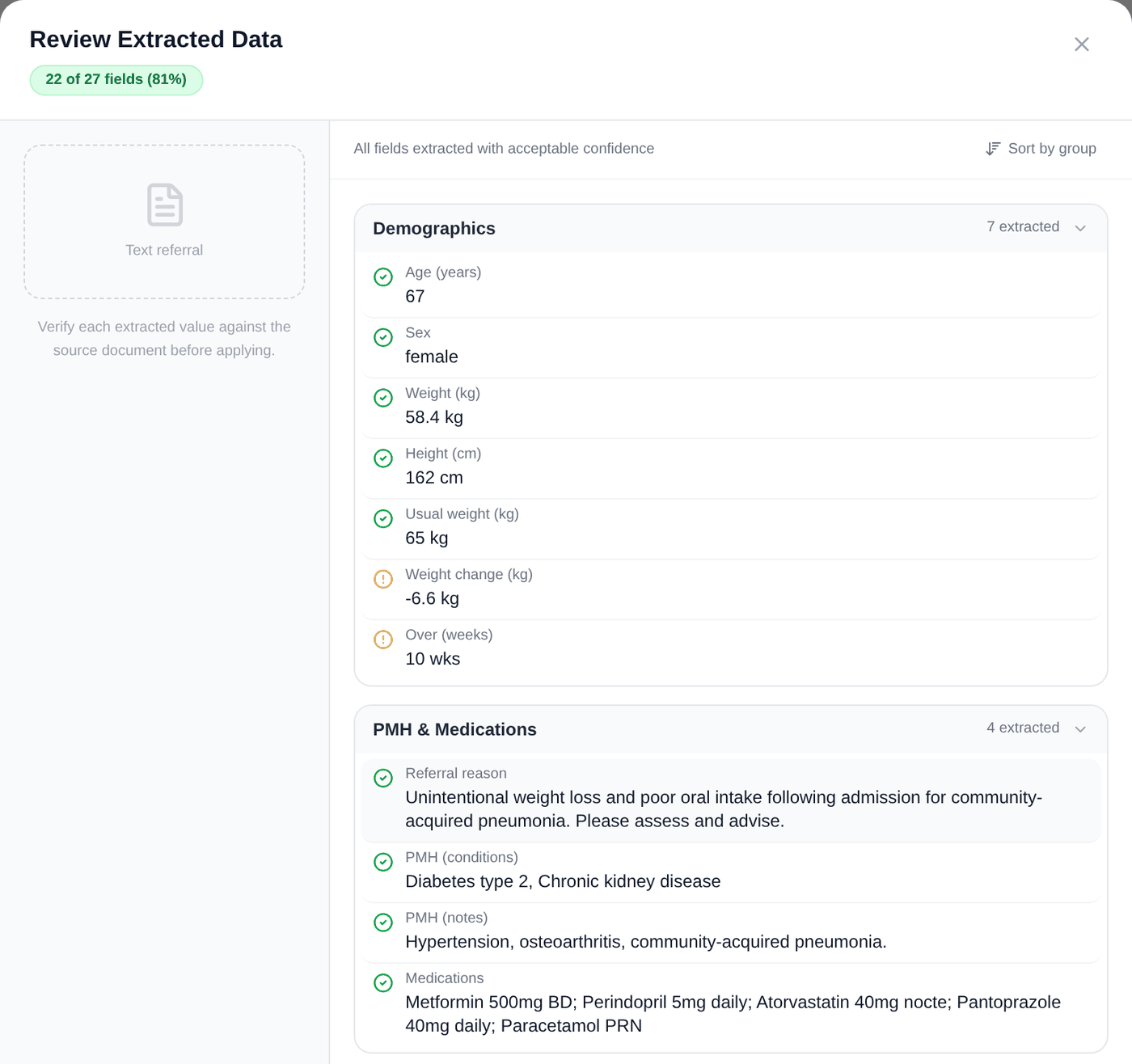
A referral after extraction. Green values were stated clearly in the referral; amber ones, like the weight change, were inferred and are worth checking before you apply them.
Every one of those outputs is a draft. You read it, fix what is wrong and sign it. We have written about the limits we build in on purpose in What AI should not do in a clinical note.
Newer features that give time back
Most of what we have added recently is not headline AI. It is the admin around the consultation, removed one piece at a time.
- Patients complete their intake before they arrive. Send a link and the patient fills in their health history, medications, allergies, a guided snapshot of what they usually eat, and their goals. You review what they entered rather than asking every question in the room, and the appointment starts at the conversation.
- Dictate in the language you speak. Set the language you dictate in and the note is still written in English, so a clinician who thinks and speaks in another language is not forced to type.
- Everything after the note is one click away. Once a note is saved, the GP letter, a translated summary, a meal analysis and a follow-up are offered from the same screen, with that patient and that note already filled in.
- GP letters leave finished. Export to Word or PDF on your own practice branding, instead of pasting into a template and reformatting.
- Reminders patients can act on. Schedule food diary or weight reminders, and the patient logs straight from a link, with no app to install.
- Meal plans say where the numbers came from. Nutrients in an AI-drafted meal plan are calculated from the Australian Food Composition Database wherever the food can be matched confidently, and the handout marks which figures are estimates.
- New enquiries get a drafted reply. The enquiry responder drafts an answer to a prospective client’s email from your own practice documents, and steers clinical questions towards booking rather than answering them.
- Handover between colleagues. When a client moves to another dietitian in your practice, for leave or permanently, the receiving clinician gets a proper brief rather than a phone call.
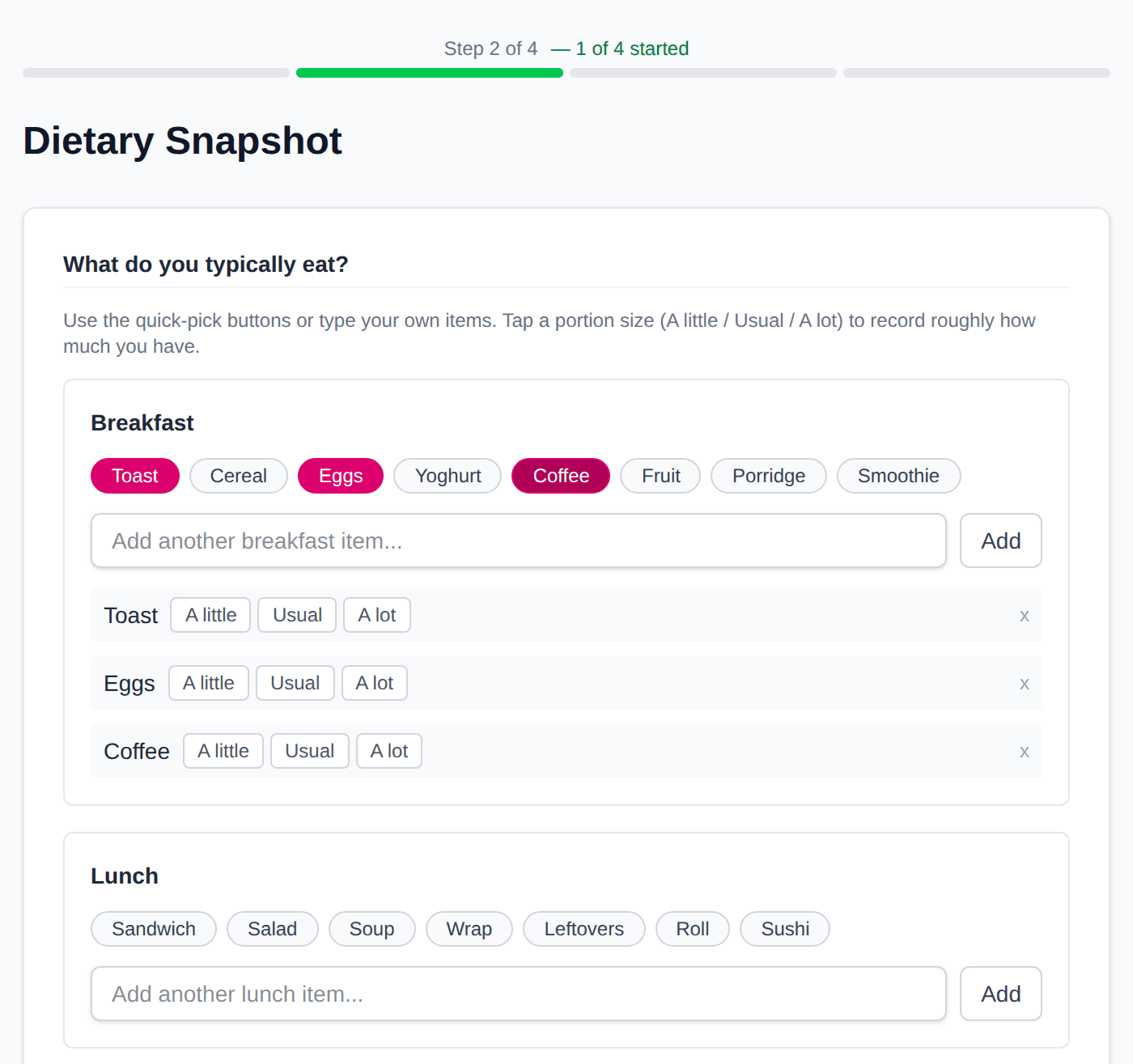
The patient fills in the dietary snapshot on their own device before the appointment, picking common foods and a rough portion for each.
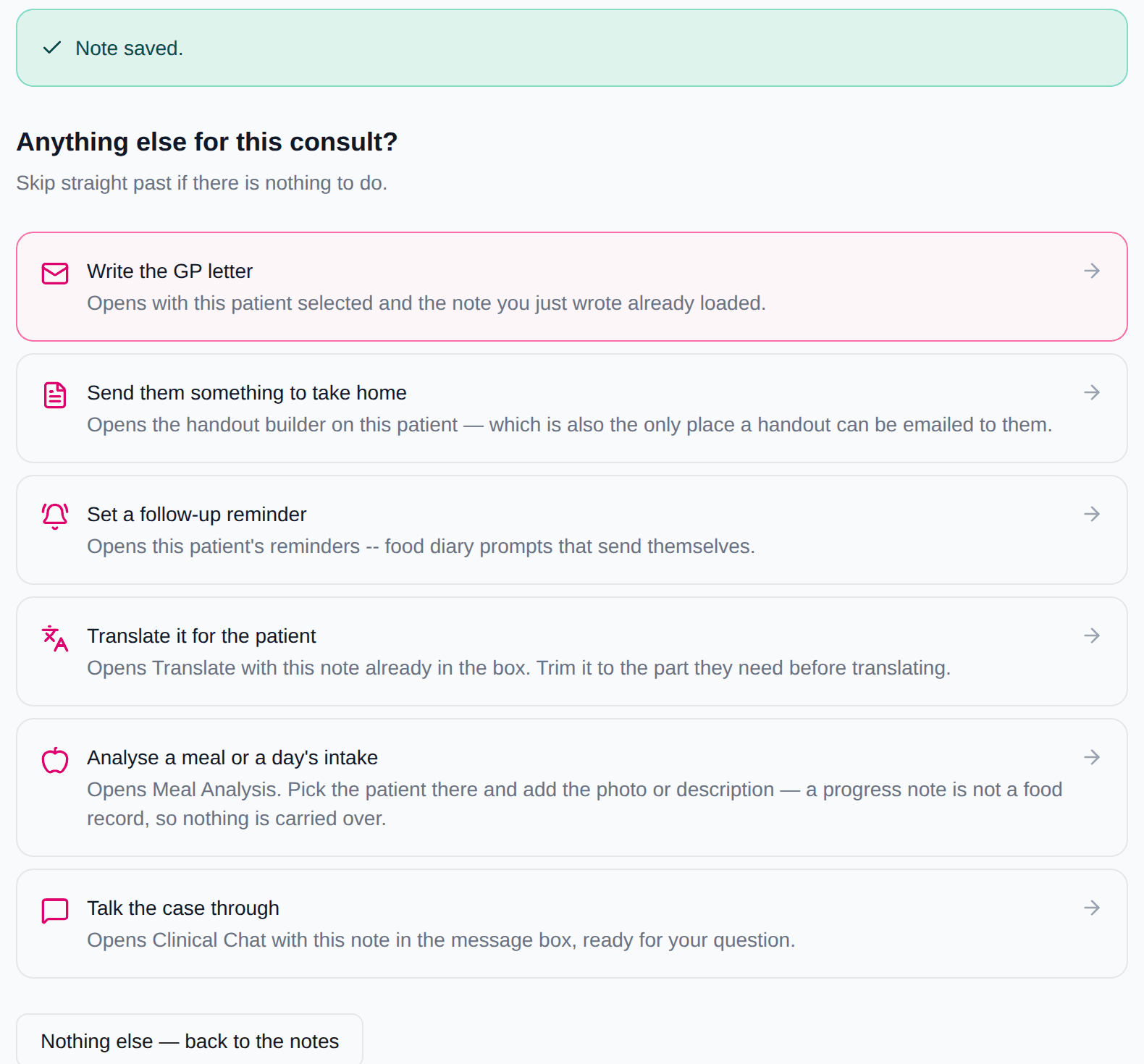
After the note is saved, every next step for that consult is offered on one screen, with the patient and the note already loaded.
Each of these saves minutes, not hours. Across a full caseload, minutes are where the week goes.
The dietitians who adopt it will pull ahead
AI will not replace dietitians. It is, however, likely to widen the gap between dietitians who use it well and those who do not.
The reason is simple. If two dietitians are equally skilled, and one spends much less time on each note, letter and intake form, that dietitian has more time for everything else: longer consultations, more patients seen, faster turnaround on GP letters, and evenings that are not spent catching up on documentation. Over a year, that adds up to a noticeably different practice.
There is early evidence for this from medicine. In a 16-week rollout of AI scribes to outpatient clinicians at Kaiser Permanente, use was associated with less time spent on documentation and a positive experience for clinicians and patients. The same study also found some incorrect outputs, which is why the review step matters as much as the time saved.
This has happened before. Electronic records, telehealth and online booking all went from unusual to expected. The clinicians who learnt them early did not lose their jobs to the technology. They got better at their jobs because of it.
Why this is good for patients
It is easy to frame this as a question about dietitians’ careers. It is really a question about patient care, and on that measure the answer is clearly positive.
- More of the appointment is spent on the patient. Less time looking at a keyboard means more time listening.
- Letters reach the GP sooner. A letter drafted from the consultation you just documented goes out the same day, not at the end of the week.
- Information is easier to understand. A handout in the language someone reads at home is more likely to be read and followed.
- Fewer details get lost. A referral read carefully into a structured intake, with uncertain values flagged, is less likely to miss the medication or the lab result that changes the plan.
The patient still gets a dietitian. They get one with more time and better information in front of them.
Where the caution belongs
Being positive about AI does not mean being uncritical about it. The Australian Commission on Safety and Quality in Health Care published an AI Clinical Use Guide for clinicians in 2025, organised around what to check before, while and after you use an AI tool. A few questions are worth asking of any tool:
- Is everything a draft? Nothing should reach a patient or another clinician without your review.
- Where does the data go? Know which providers process patient information and in which country. Our own answer is in our Privacy Policy.
- Are the numbers calculated or generated? Clinical figures should come from a calculation or a food composition database, not from a model’s best guess.
- Can you see what it changed? Software that silently edits what you wrote is asking you to sign text you have not read.
Where to start
You do not need to rebuild your practice around AI. Pick the one admin task that costs you the most time each week, usually the note, the referral or the GP letter, and try handing the first draft to software. Check its work closely at first. If the draft is good enough to edit, rather than rewrite, you have your time back.
References
- Dietitians Australia, Digital health role statement (2024).
- Dietitians Australia, Professional Practice Standards
- Australian Commission on Safety and Quality in Health Care, AI Clinical Use Guide (2025).
- Tierney AA, Gayre G, Hoberman B, et al. (2024). Ambient artificial intelligence scribes to alleviate the burden of clinical documentation. NEJM Catalyst 5(3).
- Allman-Farinelli M. (2023). Digital dietetics and the era of artificial intelligence. Nutrition & Dietetics 80(4):334-337.
- FSANZ, Australian Food Composition Database
- Our Privacy Policy sets out which providers process what, and where.
AI Dietitians produces drafts to support clinical documentation. It does not provide diagnosis or treatment decisions and is not a medical device. The treating clinician remains responsible for all clinical content and for what is communicated to patients and other providers.