Resources
MST, MUST or GLIM: which does what
A recurring source of confusion, and it matters more than it sounds: MST and MUST are screening tools. GLIM is a diagnosis. They answer different questions, they sit at different points in the process, and a service that treats them as interchangeable tends to screen diligently and then never code anything.
Here is what each one is for.
MST: two questions, at the front door
The Malnutrition Screening Tool asks two things — has your appetite been poor, and have you lost weight without trying — and produces a score from 0 to 5.
- Appetite decreased: 1 point
- Weight loss: up to 5 kg = 1, up to 10 kg = 2, up to 15 kg = 3, more than 15 kg = 4. Unsure = 2.
- A total of 2 or more means at risk, and triggers assessment.
Two details are worth pausing on.
“Unsure” scores 2, not 0. A patient who does not know whether they have lost weight is treated as meaningful risk, because not knowing is itself informative — people who have lost a lot of weight slowly are frequently the ones who cannot say.
And the threshold is deliberately low. MST is built to over-refer. It is a net, not a verdict: the cost of a false positive is one assessment, and the cost of a false negative is a missed malnourished patient.
MST was developed for Australian adult acute hospital patients (Ferguson et al., 1999) and is the tool most Australian hospital screening policies are written around.
MUST: five minutes, and a management plan attached
MUST adds BMI and an acute disease effect to the weight-loss question, and produces low, medium or high risk with management guidance attached to each band.
It takes longer than MST and gives you more. In practice the choice between them is usually made by your service’s policy rather than by you, and that is the right level for the decision — screening consistency across a ward matters more than which of two good tools you picked.
GLIM: the diagnosis, and the two-step that gets skipped
GLIM is not a screen. It is a diagnostic framework, and it is explicitly a two-step process:
Step 1 — a validated screening tool must be positive first. GLIM does not start from nothing; it starts from a positive MST, MUST, NRS-2002 or equivalent.
Step 2 — for a diagnosis you need at least one phenotypic criterion and at least one aetiological criterion. Phenotypic: weight loss, low BMI, reduced muscle mass. Aetiological: reduced intake or assimilation, or disease burden and inflammation.
Severity is staged on the phenotypic criteria only. Aetiology tells you why; phenotype tells you how bad.
The step most often skipped is the first. GLIM applied without a positive screen is not GLIM — the consensus is explicit that screening precedes diagnosis.
Why this sequence pays for itself
A completed GLIM diagnosis is one of the assessments that supports ICD-10-AM coding for malnutrition. In an admitted setting, coding is what makes the dietetic work visible in the hospital’s activity data, and therefore in its funding.
The common failure is a ward that screens every patient with MST, refers appropriately, assesses thoroughly — and stops at “malnutrition present” in the notes. The clinical work is done. The diagnosis that would carry it into the coded record is not.
That is not a clinical failure. It is a documentation one, and it is expensive in a way that never shows up in a clinical audit.
In AI Dietitians
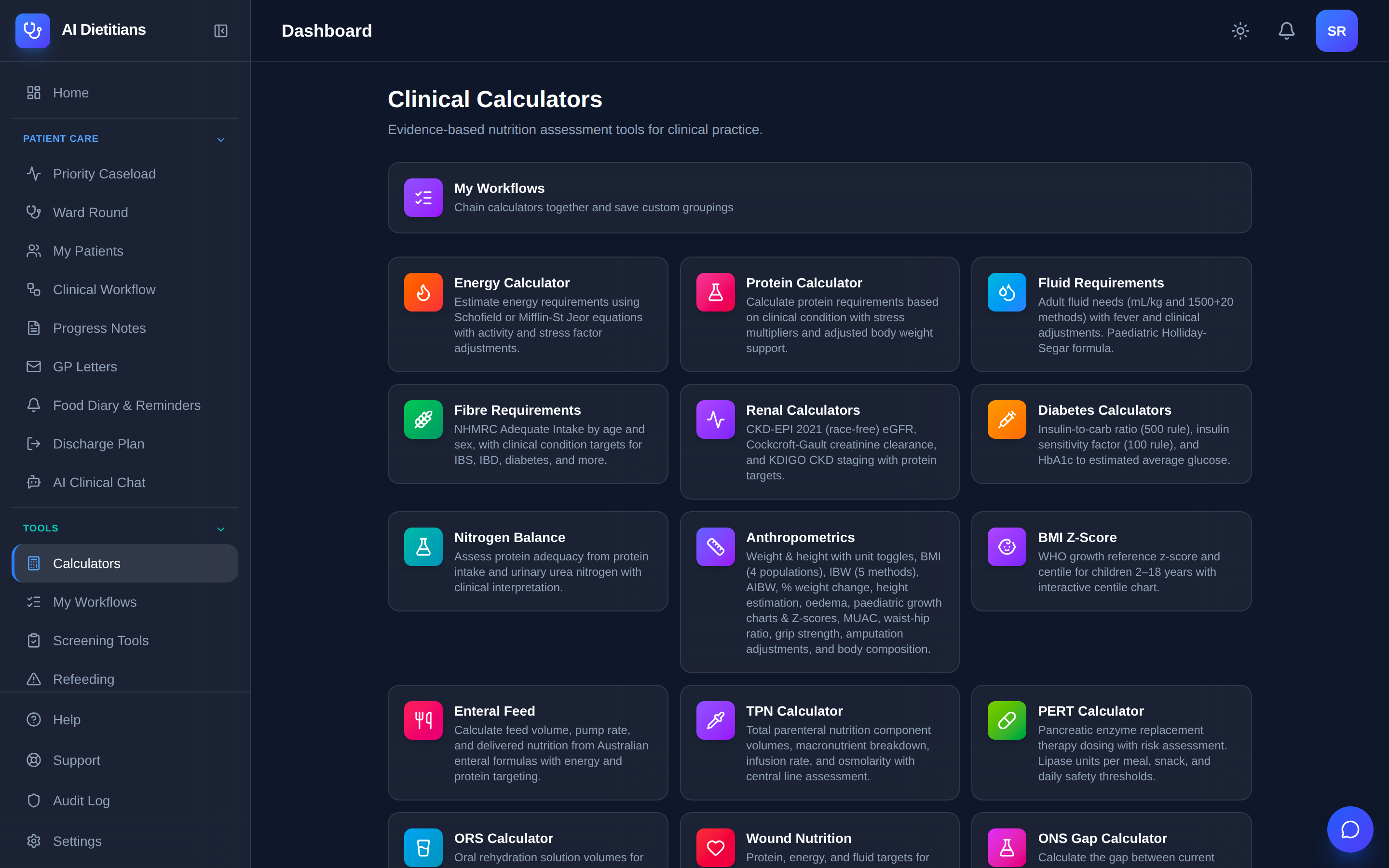
MST, NRS-2002, SGA, STAMP and GLIM are all in the platform, and GLIM composes with an ICD-10-AM coding helper so the diagnosis and the code are produced from the same assessment rather than reconstructed later. MUST is not: it is BAPEN’s instrument, so the platform does not reproduce it, and BAPEN’s own calculator is the place to score it.
Each calculator shows its working — the score, the band, and the line-by-line arithmetic that produced it — because a number you cannot audit is a number you cannot defend in a case conference.
You can use the free malnutrition screening reference with no account. For the two screens side by side, see MUST vs MST; for the full sequence from screen to code, see how to screen, diagnose and code malnutrition.
References
- Ferguson M, Capra S, Bauer J, Banks M (1999). Development of a valid and reliable malnutrition screening tool for adult acute hospital patients. Nutrition 15(6):458-464.
- Cederholm T, Jensen GL, Correia MITD, et al. (2019). GLIM criteria for the diagnosis of malnutrition — a consensus report. Clinical Nutrition 38(1):1-9.
- BAPEN, Malnutrition Universal Screening Tool (MUST)
- Independent Health and Aged Care Pricing Authority, ICD-10-AM / Australian Coding Standards
This article is educational information for clinicians. Screening tools identify risk and are not diagnostic. Always work from your own service’s screening policy and the current published criteria, and apply your clinical judgement to the individual patient.