Resources
Twenty-five calculators, one tab
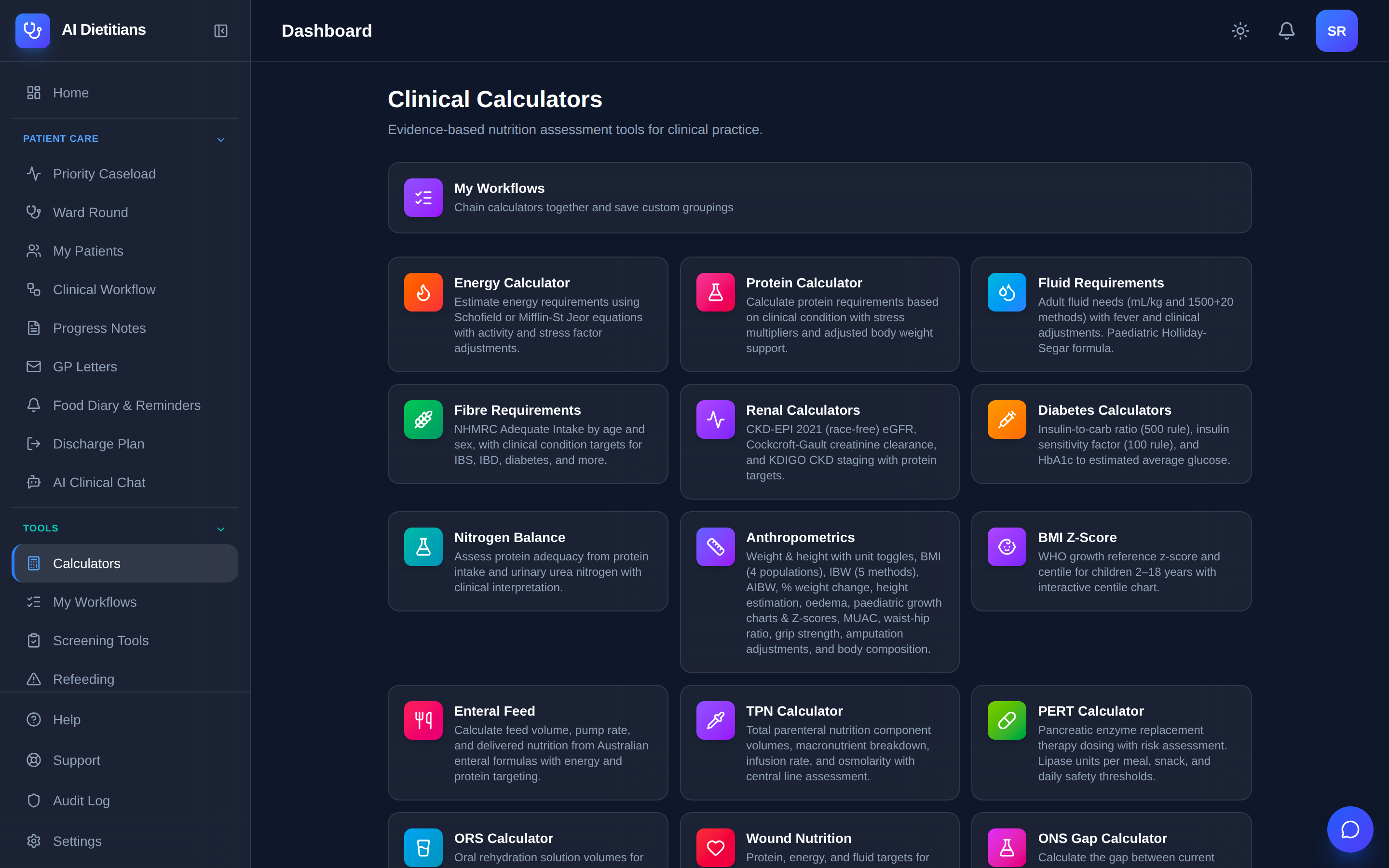
Every dietitian has a folder of spreadsheets, a laminated card, and three browser tabs. The arithmetic is not the slow part — finding the right tool, re-entering the same weight into it, and copying the answer back into the note is the slow part.
What is in there
Energy (Schofield and Mifflin-St Jeor with activity and stress factors), protein with stress multipliers and adjusted body weight, fluid (mL/kg and the 1500+20 method, plus paediatric Holliday-Segar), fibre against NHMRC Adequate Intake, renal (CKD-EPI 2021 race-free eGFR, Cockcroft-Gault, KDIGO staging), diabetes ratios, nitrogen balance, anthropometrics, BMI z-score against WHO references, enteral feed, TPN, PERT, ORS, wound nutrition and the ONS gap.
Twenty-five in total. The marketing line says “20+”, which understates it.
Every one shows its working
This is the part that matters in a case conference. Each calculator returns not just a number but the line-by-line arithmetic that produced it — which equation, which weight, which factor, in order.
A number you cannot audit is a number you cannot defend. When a registrar asks why the target is 1,850 kcal rather than 2,100, “the calculator said so” is not an answer, and having the working in front of you means you never have to give it.
Chained, not isolated
Calculators feed each other. An anthropometric assessment produces the adjusted body weight that the protein calculator needs. A refeeding risk assessment produces the starting rate that the enteral feed calculator titrates from. You can save a chain of calculators you use together as a named workflow and run it as one.
That is where the time actually goes — not in any single calculation, but in the ten re-entries between them.
Australian references, not converted ones
Fibre against NHMRC Adequate Intakes. Food composition from the Australian Food Composition Database. IDDSI for texture. Australian screening tools. Growth references appropriate to the population being assessed.
This is the difference between software built here and software built elsewhere and lightly adapted, and it shows up in the small numbers that make a report defensible.
References
- NHMRC, Nutrient Reference Values for Australia and New Zealand
- FSANZ, Australian Food Composition Database
- KDIGO, CKD Evaluation and Management Guideline
- Inker LA et al. (2021). New creatinine- and cystatin C-based equations to estimate GFR without race. NEJM 385:1737-1749.
Calculators support clinical assessment and do not replace clinical judgement. Always confirm outputs against your service’s protocols and the current published references.